Amy analyzes the factors that determine how much garbage a family produces per week. Factors including the size of the house, the number of children, and the number of adults who are usually home during the day are considered. Below is the report produced by a regression routine. Answer the following questions. You should provide reasoning and justifications for your solution. OLS Regression Results: Dep. Variable: Garbage | R-squared: 0.170 Model: OLS | Adj. R-squared: [UNK1] Method: Least Squares | F-statistic: 29.80 No. Observations: 440 | Prob (F-statistic): 1.52e-17 Df Residuals: [UNK2] | Log-Likelihood: -1194.7 Df Model: 3 | AIC: 2397. | BIC: 2414. Coefficients: Intercept: coef=7.1943, std err=1.092, t=[UNK3], P>|t|=0.000 Q("House Size"): coef=0.0019, std err=0.001, P>|t|=0.001, [0.025]=0.001, [0.975]=0.003 Children: coef=1.1028, std err=0.141, P>|t|=0.000, [0.025]=0.826, [0.975]=1.379 Adults: coef=1.0425, std err=0.233, P>|t|=0.000, [0.025]=0.585, [0.975]=1.500 Omnibus: 0.193 | Durbin-Watson: 1.963 Prob(Omnibus): 0.908 | Jarque-Bera (JB): 0.272 Skew: 0.044 | Prob(JB): 0.873 Kurtosis: 2.916 | Cond. No.: 1.14e+04 (1) Compute the value of adjusted R-squared (UNK1) based on available information. (5%) (2) Compute the residual degree of freedom (UNK2) and the t-value of the Intercept (UNK3) based on available information. (4%) (3) Conduct the following hypothesis test (using 95% significance level): H0: Coefficients of all independent variables are jointly zero. H1: At least one independent variable has a non-zero coefficient. (6%)
原始試卷圖片
查看完整試卷 PDF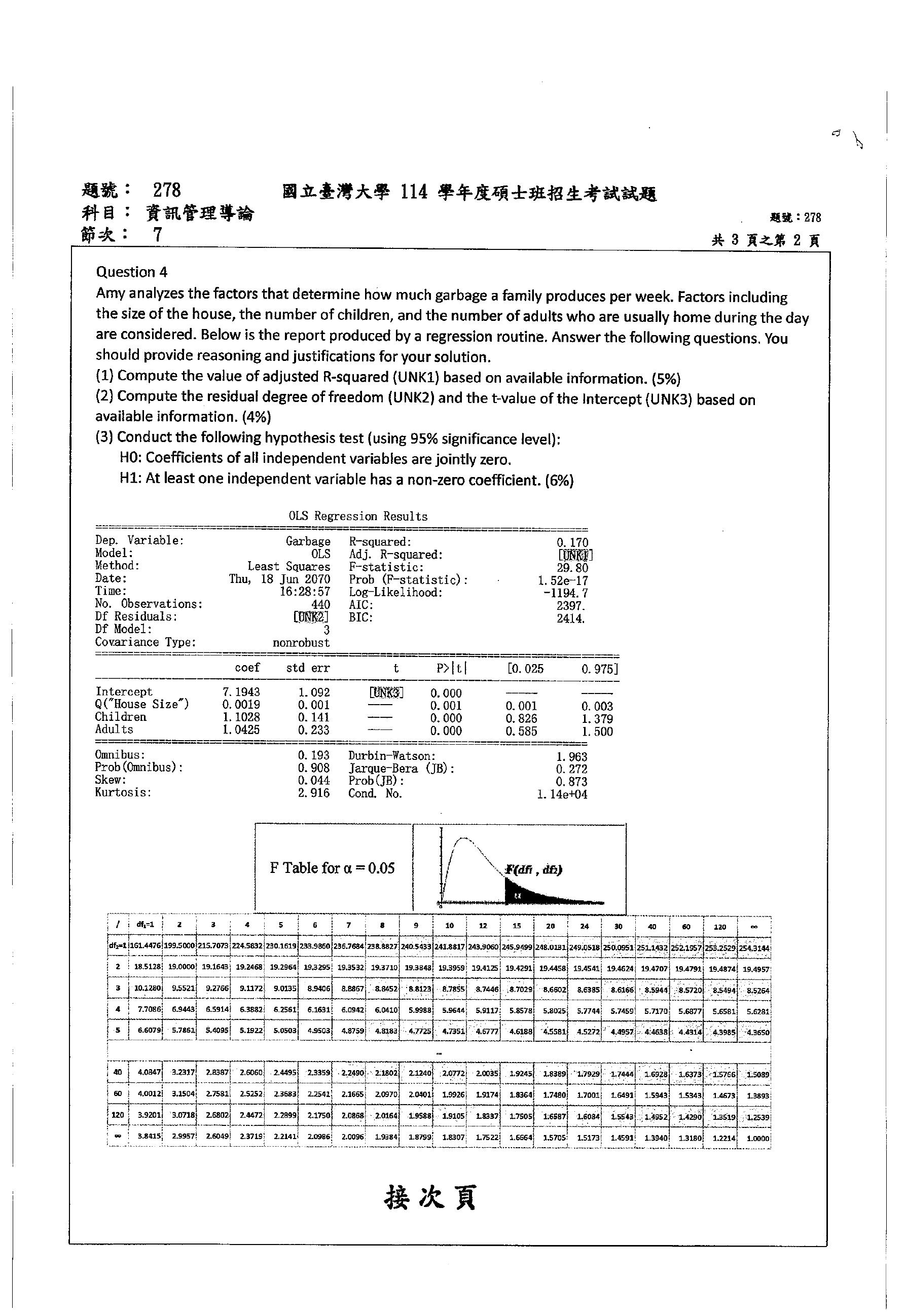
這是申論或開放題,不使用 A–E 自動判分。請先在紙上完成答案,再查看參考解析並自行評估。